

Choosing a new roof in Inglewood means thinking about more than appearance. Southern California sun, warm roof surfaces, energy efficiency, the structure of an existing home, and local permitting requirements can all affect which roofing system makes sense.
Quick answer: For many Inglewood homeowners, a cool roof is the most practical choice when heat management, conventional installation, and code compliance are priorities. Solar shingles may appeal to homeowners who want roofing and solar generation integrated into one system. Synthetic slate can provide a distinctive slate-style appearance without using natural slate. The best choice depends on your roof structure, budget, energy goals, and architectural preferences.
What local homeowners should know
-
Cool roofing products are designed to reflect more solar energy and release absorbed heat more effectively than conventional roofing products.
-
Inglewood residential reroofing projects are subject to local permit requirements, so material selection should be evaluated before installation begins.
-
Solar shingles combine weather protection with electricity generation, but roof orientation, shading, usable roof area, and system design matter.
-
Synthetic slate can be attractive for homeowners who want a traditional or upscale appearance, but product specifications and structural compatibility still need to be reviewed.
-
Homes around North Inglewood, Morningside Park, Century Heights, and neighborhoods near SoFi Stadium can have different roof shapes, slopes, ages, and existing materials.
Which Roofing Material Is Best for Inglewood Homes?
The best roofing material for an Inglewood home is the one that balances heat performance, roof condition, structural compatibility, appearance, and long-term goals rather than simply choosing the newest or most expensive option. Cool roofs are often worth considering for heat-conscious homeowners, while solar shingles and synthetic slate address more specialized priorities.
A house near Downtown Inglewood may have different roofing needs from a property near Morningside Park or the Los Angeles city boundary. Roof pitch, existing decking, shade, architectural style, and whether the project includes a complete tear-off can change the decision.
Wide Awake Roofing helps local homeowners evaluate roofing options based on the actual property. We can assess the existing roof system and discuss which materials make practical sense before a replacement project moves forward.
Why Does Roofing Material Matter So Much Locally?
Roofing material matters locally because Inglewood homes experience substantial Southern California sun exposure, while California energy standards and local permitting add practical considerations to a reroofing decision. A roof needs to manage weather exposure while also fitting the building, its ventilation and insulation, and applicable project requirements.
The California Energy Commission maintains standards for qualifying cool roofing products and uses Cool Roof Rating Council ratings for solar reflectance and thermal emittance.
Local records also show that cool roofing is not merely theoretical in this market. City of Inglewood permit records include residential projects specifying asphalt cool roof shingles, composition cool roof materials, and Title 24 roofing products.
That makes material performance especially relevant for homeowners throughout this part of Los Angeles County.
How Do Solar Shingles Work?
Solar shingles work by combining roof-covering components with photovoltaic technology that generates electricity from sunlight, giving homeowners an alternative to installing conventional roofing with separate rack-mounted solar panels. Their biggest appeal is an integrated roof appearance, but suitability depends heavily on the individual property.
Solar exposure is critical. Trees, nearby buildings, roof orientation, penetrations, and complex roof geometry can reduce the usable solar area.
California’s Energy Code also contains solar photovoltaic requirements for certain newly constructed residential buildings. Those requirements do not automatically mean an existing home’s reroof must use solar shingles. Alterations to existing homes should be evaluated according to the requirements that apply to that specific project.
For an existing Inglewood house, homeowners should consider solar shingles primarily because they fit their energy and design goals, not because they assume every reroof requires them.
What Are the Advantages of Synthetic Slate Roofing?
Synthetic slate roofing offers the visual character of slate through manufactured roofing products, making it an option for homeowners who prioritize architectural appearance but do not necessarily want a traditional natural-slate installation. Product weight, fire classification, installation requirements, and manufacturer specifications should still be checked carefully.
Synthetic slate may be particularly interesting when remodeling a home where the roof is a major part of the street-facing design.
However, appearance should not make the decision by itself. Before changing materials, the roof deck and supporting structure need to be evaluated for the selected system. Flashing details, roof slope, ventilation, underlayment, and compatible installation methods also matter.
For properties throughout Inglewood and nearby communities such as Hawthorne and Westchester, the right question is whether a particular synthetic slate system fits both the house and local project requirements.
Why Are Cool Roofs Worth Considering in Inglewood?
Cool roofs are worth considering in Inglewood because qualifying materials are designed to reflect more solar energy and emit absorbed heat, which can reduce roof surface heat gain during sunny Southern California conditions. They are available in roofing categories suitable for different roof types, including some shingle systems.
The California Energy Commission relies on Cool Roof Rating Council product ratings when determining values used for Energy Code compliance.
Local permit history provides another useful indicator. City records have documented reroofing projects using cool roof composition shingles and asphalt cool roof shingles on residential properties.
A cool roof does not automatically make every house comfortable or eliminate cooling costs. Insulation, ventilation, air sealing, building orientation, HVAC performance, and occupant behavior all affect indoor conditions.
Still, for a roof that receives significant sun, reflectance is a sensible factor to consider when comparing replacement materials.
What Warning Signs Mean You Need More Than a Material Comparison?
Warning signs such as active leaks, damaged decking, deteriorated flashing, or widespread roof wear mean the existing roofing system should be inspected before you focus on choosing a replacement material. A premium roofing product cannot correct underlying structural or moisture problems that are ignored during installation.
Watch for:
-
Missing, cracked, curled, or badly deteriorated roofing materials
-
Water stains on ceilings or inside the attic
-
Soft or visibly damaged roof decking
-
Damaged flashing around vents, chimneys, or roof transitions
-
Recurring leaks after previous repairs
-
Sagging or visibly uneven roof areas
-
Deteriorated fascia or roof-edge components
These conditions can change the scope of an Inglewood reroof and may affect which replacement materials remain practical.
When Should You Call a Professional Roofer?
You should call a professional roofer when leaks, widespread deterioration, structural concerns, or a planned material change make it necessary to evaluate more than the visible roof surface. Homeowners can safely perform visual checks from the ground, but walking on a damaged or steep roof creates unnecessary risk.
Professional evaluation becomes particularly useful when comparing solar shingles, synthetic slate, and cool roofing because these are not interchangeable products.
The City of Inglewood’s residential reroof permit requirements ask for details including the roofing type, roof covering classification, project area, whether existing roofing will be removed, existing roofing layers, and information about roof sheathing when applicable.
Understanding those conditions before choosing a system can prevent a material decision from getting ahead of the actual roof.
What Common Local Conditions Affect Roof Performance?
The most important local conditions affecting roof performance include sun exposure, existing roof age and condition, roof geometry, drainage, and the construction of the underlying roof assembly. These factors can make the same roofing material perform differently from one property to another.
-
Strong sun exposure: Unshaded roof surfaces can receive prolonged solar exposure, making reflectance and heat management important considerations.
-
Older roof assemblies: Existing homes may reveal deteriorated sheathing or previous roofing layers once tear-off begins.
-
Low-slope roof sections: Some properties combine pitched and flatter roof areas, which can require different roofing systems rather than one material across every surface.
-
Roof penetrations and transitions: Vents, skylights, walls, valleys, and other transitions increase the importance of proper flashing.
-
Shade and orientation: These factors are especially important when considering solar shingles because electricity production depends on usable solar exposure.
How Can You Maintain a Roof in Southern California?
Southern California roof maintenance should focus on regular visual inspections, clear drainage, flashing condition, debris removal, and checks after unusually strong wind or rain. Catching small defects before water reaches the decking or interior can help homeowners avoid more extensive repair work.
From the ground, look for missing materials, displaced flashing, clogged drainage areas, or visible changes in the roofline. Gutters and roof drains should remain clear where applicable.
Before the wetter part of the year, an inspection can also identify vulnerable penetrations and previous repair areas.
DIY maintenance should stop when accessing the roof requires climbing, when electrical or solar components are involved, or when suspected structural damage is present.
What Results Can You Expect From Each Roofing Option?
Homeowners can expect different outcomes from solar shingles, synthetic slate, and cool roofs because each option addresses a different primary goal: integrated solar generation, architectural appearance, or improved solar reflectance. None should be considered universally superior without evaluating the house itself.
Solar shingles can create a more integrated solar appearance while generating electricity where site conditions support production.
Synthetic slate can significantly change the architectural character of a house and provide a slate-inspired appearance.
Cool roofing can improve the roof surface’s ability to reflect solar energy when a qualifying product is selected and properly installed.
Actual lifespan, energy performance, maintenance needs, and costs vary by product and installation conditions, so homeowners should compare specific systems rather than broad material labels.
What Mistakes Should Homeowners Avoid?
The biggest roofing mistake is choosing a material based on appearance or marketing before confirming that it suits the roof structure, slope, climate exposure, and permitting requirements. Inglewood homeowners can make a better decision by comparing complete roofing systems rather than surface materials alone.
Mistake: Choosing solar shingles without evaluating shade and roof orientation.
Consequence: Some roof areas may provide limited useful solar exposure.
Better approach: Evaluate usable solar area before selecting the system.
Mistake: Selecting synthetic slate solely for appearance.
Consequence: Important structural and installation considerations may be overlooked.
Better approach: Confirm product specifications and roof compatibility first.
Mistake: Assuming every light-colored roof is automatically a compliant cool roof.
Consequence: Appearance alone does not establish rated performance.
Better approach: Check applicable Cool Roof Rating Council ratings and current project requirements.
What Is a Common Roofing Scenario in Inglewood?
A common local scenario is an older home reaching the point where repeated repairs no longer answer the larger question of what roofing system should replace the existing material. The homeowner may then compare a conventional cool roof with premium alternatives such as synthetic slate or an integrated solar product.
Suppose tear-off also exposes areas of deteriorated sheathing. That discovery becomes more important than the original material preference because the roof substrate must be addressed before the finished roofing system is installed.
This is why an inspection and project-specific scope should come before a final product decision.
Which Roofing Services Help With Material Selection?
Roof inspection and roof replacement planning help homeowners determine whether a cool roof, synthetic slate system, solar-integrated option, or another roofing material fits the property’s actual conditions. The process should consider the existing covering, decking, flashing, drainage, roof geometry, and applicable permitting requirements.
We can help homeowners compare practical roofing solutions without treating one material as the automatic answer for every house.
Solar Shingles vs. Synthetic Slate vs. Cool Roofs: How Do They Compare?
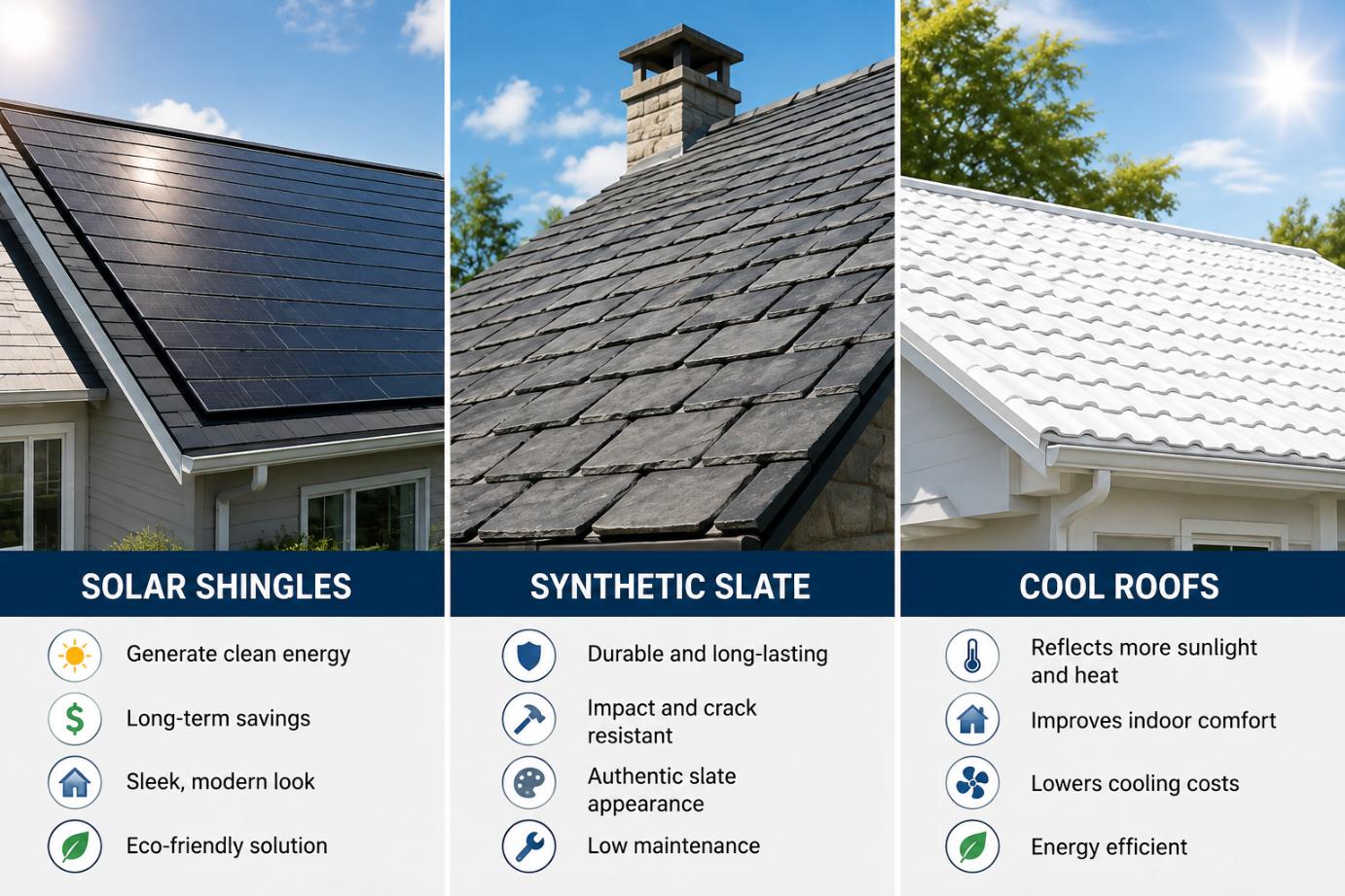
Solar shingles are strongest for integrated energy generation, synthetic slate is primarily attractive for its distinctive architectural appearance, and cool roofing is particularly relevant when solar reflectance and heat management are priorities. The right choice depends on what you want the new roof to accomplish.
| Option | Primary Appeal | Key Consideration |
|---|---|---|
| Solar shingles | Roofing plus solar generation | Sun exposure, roof geometry, system design |
| Synthetic slate | Slate-style architectural appearance | Product specifications and roof compatibility |
| Cool roof | Solar reflectance and heat management | Rated product performance and project requirements |
A homeowner prioritizing electricity generation may start with solar shingles. Someone renovating around architectural character may favor synthetic slate. A homeowner focused on a practical replacement roof for Southern California sun may find a qualifying cool roof especially compelling.
What Areas Do We Serve Around Inglewood?
We serve homeowners in Inglewood and can discuss roofing needs for properties across the surrounding service area. Local communities may include nearby areas such as Hawthorne, Lennox, Westchester, and other parts of the South Bay and greater Los Angeles area, subject to our current service boundaries.
What Can Happen If You Delay a Needed Roof Replacement?
Delaying a needed roof replacement can allow existing leaks, deteriorated flashing, or damaged roofing materials to expose the underlying roof assembly to additional moisture and deterioration. Waiting is particularly risky when there is already evidence that water has moved beyond the exterior covering.
Delay can also reduce your options if a manageable roofing problem develops into damaged decking or interior finishes.
You do not need to replace a functioning roof simply because a newer material is available. But if an inspection shows that replacement is already warranted, comparing materials early gives you more time to make a deliberate choice.
FAQ
Are cool roofs a good choice in Inglewood, CA?
Cool roofs can be a good choice in Inglewood because qualifying products are designed to reflect solar energy and release absorbed heat more effectively. Their effect on an individual home’s comfort or energy use depends on insulation, ventilation, roof design, HVAC performance, shade, and other building conditions.
Are solar shingles worth considering for an Inglewood home?
Solar shingles are worth considering when you want electricity generation integrated into the appearance of a new roofing system. Roof orientation, shading, usable solar area, system cost, and the condition of the existing roof should all be evaluated before deciding whether they are preferable to conventional roofing with separate solar panels.
Does Inglewood require a permit for residential reroofing?
Residential reroofing is subject to City of Inglewood permit requirements, and the city publishes specific information that must be included in a residential reroof permit description. Requirements include details about roofing type, classification, project size, existing roofing removal or layers, and roof sheathing where applicable.
Do California cool roof rules apply to every Inglewood roof?
Cool roof requirements depend on the building and project, so homeowners should not assume one rule applies to every reroof. California Energy Code provisions vary according to factors including occupancy, roof slope, climate zone, and project type. Current requirements should be checked for the specific property and permit.
Is synthetic slate suitable for older homes in Los Angeles County?
Synthetic slate may be suitable for an older Los Angeles County home when the chosen product and installation system are compatible with the existing structure. The roof deck, slope, flashing details, structural conditions, and manufacturer requirements should be evaluated before replacing an existing roof with a materially different roofing system.
Can a cool roof lower my air-conditioning bill?
A cool roof can reduce solar heat absorbed by the roof, but a specific utility-bill reduction should not be assumed. Insulation, ventilation, air leakage, HVAC efficiency, thermostat settings, shade, and household usage all influence cooling costs, so actual results vary substantially from one Inglewood property to another.
Can I install solar shingles on any roof?
Solar shingles are not automatically suitable for every roof because usable sunlight, orientation, shade, roof geometry, structural conditions, and system requirements affect feasibility. Complex roofs or heavily shaded sections may provide less useful solar area, which is why the property should be evaluated before choosing an integrated solar roofing system.
Should I replace my roof before installing a different roofing material?
A roof that is already deteriorated should be evaluated before a new material is selected because decking, flashing, and other underlying conditions may affect the replacement scope. For Inglewood homeowners, identifying these issues early also helps clarify permitting requirements and whether the preferred roofing system is practical.
Choose a Roof That Fits Your Inglewood Home
Solar shingles, synthetic slate, and cool roofs solve different problems. The strongest choice is the roofing system that fits your property’s structure, sun exposure, architectural goals, and applicable local requirements.
Wide Awake Roofing can help you evaluate the roof you have today and compare practical options for protecting your home.
Protect Your Inglewood Home With the Right Roofing System
Get clear recommendations based on your roof’s actual condition and your priorities, without assuming one roofing material is right for every property.